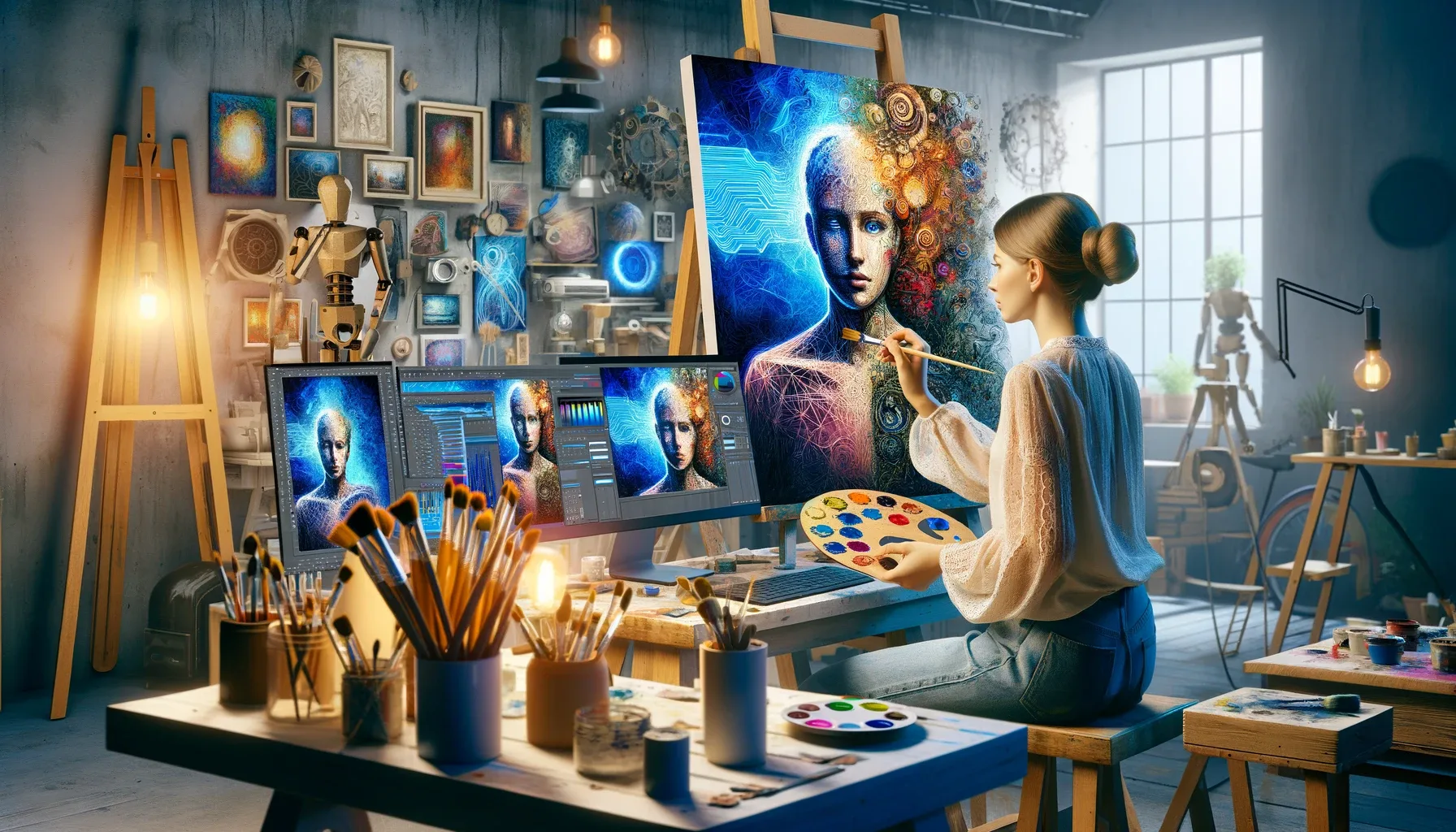
AI in the studio
AI in art expands an artist's capabilities. It studies visual information, patterns, styles, and techniques, then offers possibilities that could take a person years to conceive. It raises output and lets artists experiment at speeds that were unavailable before. It still needs the artist's direction to make work that connects with people.
Stanford University's Copyright and Fair Use Center describes transformative use: output can become a new work instead of a copy. An AI can study Van Gogh's brushstrokes, Monet's palettes, and Vermeer's compositions, then generate an original image. It learns from those elements. It does not reproduce them as a fixed work.
AI focuses and expands the artist's vision. It opens paths for artists to explore their craft. MIT Technology Review has noted the reality of current technical advances in art. The human and AI partnership in the studio is just starting, and its potential matches the range of imagination.
Artists who use AI are taking a chance to push creativity forward. New tools have always offered new perspectives and voices in human expression. AI is the newest instrument. It already draws in people who want to learn from it.
Copyright and creation
Copyright gives artists control over their work. It says people who use that work need to follow rules. Transformative use gives new works room to exist without taking the original artist's work. AI studies many styles, textures, and forms and can make a work that did not exist before.
According to Stanford's Copyright and Fair Use Center, a new work with new expression, meaning, or message may qualify as fair use. That is the case for a work that transforms material. An AI image made from a dataset can be novel. It does not photocopy an artwork. It presents its own work after study.
AI images do not directly compete with the original artwork. They can exist in different genres and reach different audiences. In this view, AI art starts from cultural material and produces new work that acknowledges its roots.
AI's place in art is creation. It learns from the past and aims toward the future. Understanding the relationship between technology and law lets people enjoy AI art in a legal and creative way.
There is also a claim that AI steals art. That claim misstates how the system works. AI absorbs a large record of human creativity and produces original work. Adobe says AI algorithms recognize patterns and learn from their data. They use that learning to make images that have not been seen before. The process is study and learning, not copying and pasting.
Human artists also work from influence. They draw, knowingly or not, from what they have seen, read, and experienced. That practice produces diverse art. AI also uses the images and styles it has encountered to make new work. The Electronic Frontier Foundation supports the view that fair use allows new transformative works.
AI art opens a market interested in technology and creativity. It can coexist with traditional work. AI and artists can work together, increasing what can be achieved. AI helps write the future of art rather than replicate the past.
A new tool in art history
Art joins tradition and progress. The studio now holds canvases, clay, screens, and AI. AI belongs with changes such as photography and tube paints. Each one gives artists another way to work.
Tube paints let Impressionists take their work outside and capture en plein air light. The Art Story calls portable paint a pivotal change that joined practical materials with artistic vision and created a movement. AI brings a similar moment. It can become another brush in an artist's palette and contribute to an artistic renaissance.
Artists have long repurposed technology for creative needs. The camera was once treated as a threat to painting. The Metropolitan Museum of Art notes that it expanded how artists could see and represent the world. It brought new genres, perspectives, and conversations in visual representation.
AI gives artists territory to explore. It works with data and algorithms while the artist directs the work. Artists can take art history, styles, techniques, and emotion and remix them into work that speaks to the present.
AI in art is an evolution. Art has the capacity to grow and adapt. From chisel to Photoshop, a tool takes its meaning from the artist who uses it. AI continues the artist's search for expression. It adds to the human element, extends what is possible, and opens a field where imagination sets the limit.
Law and the next renaissance
AI also creates a copyright conversation. Copyright establishes rules around a work. Transformative use takes existing material and turns it into something new and different. A collage made from magazine clippings is different from a photocopy. AI processes datasets, learns styles and techniques, and creates work that did not exist before.
Stanford's Copyright and Fair Use Center says a work that is sufficiently transformative can be fair use. Cornell Law School's Legal Information Institute notes that competition in the marketplace matters for fair use. An AI image that does not take sales from the original artist is less likely to be infringement.
The relationship between AI art and copyright is complex and keeps changing. Law must change with the technology. Artists, lawyers, and technologists need to make a future that respects creators' rights and allows innovation. AI is a chance for copyright law to grow through a balance between protection and new expression.
AI can analyze the history of baroque art and help an artist make a work with that essence and a modern turn. It can also translate the emotional depth of a poem into visual art. These uses are already beginning. AI strengthens an artist's voice, reach, and impact. Artists remain central to work that carries the depth of human experience.
Artists have led social shifts through technology from cave painting through the Renaissance, Impressionism, and the digital age. AI is the next step in that history. It can free artists from routine work and give them space to dream bigger. This partnership respects the artist's vision and gives it new dimensions.
The story of AI in art is expansion. It combines human emotion with computational power. As AI enters artistic practice, it gives artists chances to reach new heights and redefine what art can do. The art world is at the start of a new chapter. Creativity and algorithms will share the same page, and the future canvas is as wide as human and machine collaboration.
First published on Medium. Rewritten for this site.